Criminal Records Office
The IPCRESS FileThe Criminal Records Office is the records office at Scotland Yard through which a constable’s recognition of Housemartin becomes a warning that the narrator cannot ignore. Its importance in the episode lies in a precise distinction: a man with no ordinary criminal record can still have a green card marking him as a suspected person, and the CRO’s files can connect that record to the narrator’s department before the suspect disappears into the system.
Identity and Records
The office is identified in the text by its full name and the abbreviation CRO. Its records are divided, in the account given to the narrator, between a white card and a green card. A white card denotes a person with a criminal record; a green card is for a suspected person without one. The green card therefore does not establish a conviction. It identifies someone of interest despite the absence of a white-card record, a distinction that becomes crucial when the police bring in a man whose apparent identity is false.
The card in this case is endorsed to the narrator’s department and carries a star mark for top priority. Those details give the record practical force: the CRO is not simply reporting that a file exists, but alerting the department that the entry has already been marked for urgent attention. The episode does not explain how the office creates or maintains such cards, or define the full scope of its records. It does show that its classification system can preserve information about a suspect who would otherwise appear to have no criminal record.
The Call from the CRO
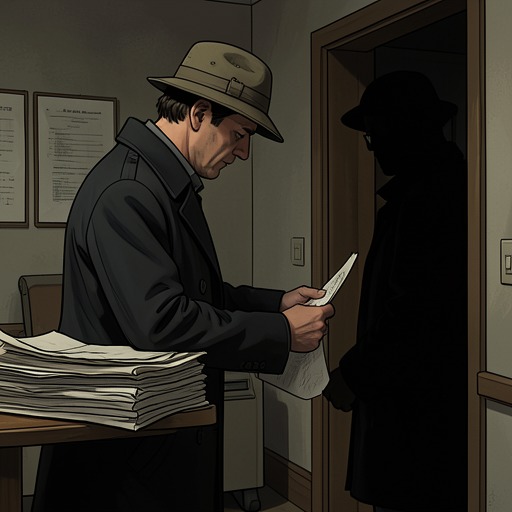
The CRO contacts the narrator through Captain Keightley, its Military Liaison Officer. The call comes in as a class-four priority communication, and the narrator scrambles the line before speaking. Keightley initially reports the essential discrepancy: the man has no white card, but a green one is on file. When the narrator asks how the card was located, Keightley explains that the man did not give a name. Instead, he was dressed as a Metropolitan Police Chief Inspector.
The recognition begins with a constable who had once worked at the CRO. Having seen Housemartin’s photograph there, he recognizes the face when the disguised man is brought in. The constable first thinks the office may have a white card; checking the records reveals the green card instead. Keightley then calls the narrator to ask what the police should do with the information and whether they should tell Shoreditch. The sequence depends on both the constable’s memory and the record: the photograph makes recognition possible, while the green card supplies the departmental connection that turns a suspicious disguise into a matter of immediate security concern.
From Record to Detention
The narrator orders Keightley to have the man held and searched, with particular caution about cyanide pills. He insists on constant observation and holds the local chief responsible for the prisoner’s safety. He also asks that the constable who made the recognition be made a sergeant on the spot, treating the identification as unusually valuable. Keightley says the narrator is leaving immediately and will arrive before 7:30.
The CRO does not itself conduct the arrest or establish what the suspect intended. Its role in the episode is to relay the record and connect the local police action to the narrator’s department. The narrator’s instructions show how quickly that information changes the response: the man is to be kept under lock and key, watched, and searched for a possible means of self-harm. The card is thus a lead, not a conclusion; it prompts protective custody and further investigation rather than resolving the suspect’s identity or affiliations on its own.
Narrative Significance
The CRO’s contribution is modest in form but decisive in effect. A routine-looking records distinction, combined with one constable’s prior familiarity with a photograph, exposes the vulnerability of a disguise that imitates police authority. The man’s assumed rank does not prevent scrutiny once his face is recognized and the office’s file is checked. At the same time, the green card makes clear that the absence of a criminal record is not the same as an absence from official records.
The scene also presents the CRO as an information link within a larger security response, rather than as an all-knowing investigative body. Its call carries a high-priority endorsement, but the narrator must decide what action to take, and the police station must keep the prisoner safe. The office matters because its records can make an otherwise isolated recognition actionable: a photograph is remembered, a card is found, and the narrator is brought into the case before the chain of events can be treated as an ordinary police matter.